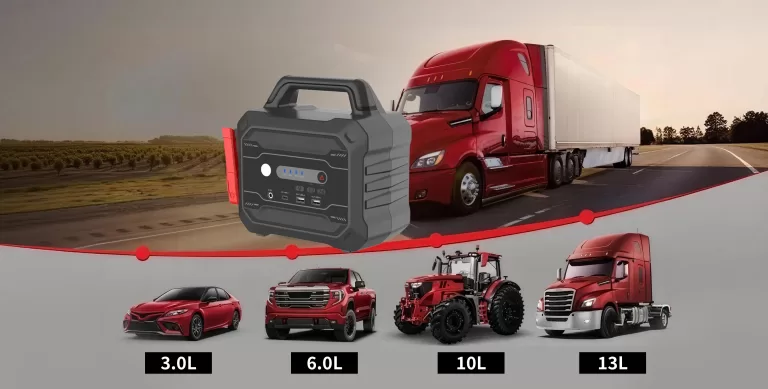



When it comes to marketing a single number like CCA, different types of starting batteries often show varying cold cranking amp ratings, even for the same vehicle. This is why the market may present multiple “different” CCA options that are all technically suitable for the same application.
In essence, CCA is designed to answer a simple decision question: can this battery reliably start my vehicle? However, it is not an isolated performance metric. It is a reference value built on OEM specifications, which already take into account engine starting requirements, temperature variation, and battery aging. In this sense, OEM CCA acts more like a safety baseline rather than a strict selection rule.
How Many CCA Does My Vehicle Require?
The OEM specification is the most important reference when determining required CCA. Vehicle manufacturers calculate this value based on engine displacement, electrical system design, and operating conditions.
In most cases, selecting a battery that meets or slightly exceeds the OEM-recommended CCA range is sufficient. This ensures the battery can reliably support engine starting under normal conditions without unnecessary oversizing. However, this leads to a second important question.
Do I Really Need More CCA Than The OEM Spec?
Not necessarily. Once the OEM-required threshold is met, increasing CCA does not significantly improve real-world starting performance. Higher-rated batteries within the same vehicle application often reflect different design configurations rather than meaningful gains in ignition capability.
In practice, the engine’s starting requirement remains within a fixed operating range, meaning that performance is determined more by meeting the baseline than exceeding it.
What Else Should I Consider Besides CCA?
Modern vehicles place increasing demand on electrical systems even when the engine is off. Features such as ADAS, GPS navigation, OTA updates, keyless entry, connected services, and onboard security systems continuously draw power.
As a result, total energy consumption has increased, while engine cranking demand has remained relatively stable. This shifts battery selection criteria beyond CCA toward broader system performance factors such as:
1. Battery chemistry
2. Weight
3. Cycle life
4. BMS protection systems
5. Environmental impact
Among these, amp-hour capacity (Ah) and Reserve Capacity (RC) have become increasingly important, as they determine how well a battery can support continuous electrical loads and repeated charge-discharge cycles.
This is also why OEMs often adopt larger battery formats such as H6, H7, and H8. The primary goal is not higher CCA, but improved energy storage and longer service life under modern vehicle electrical demands. Battery chemistry.
Can Sodium-ion Battery Update Lead-acid?
Taking sodium-ion starting batteries as an example, the discussion goes beyond CCA alone. A sodium-ion battery can deliver the required cold cranking amps for vehicle starting while also offering additional system-level advantages such as lighter weight, longer service life, and improved environmental sustainability due to its lead-free chemistry.
Compared with simply increasing CCA in traditional designs, sodium-ion technology focuses on overall performance and long-term value.
While AGM and EFB lead-acid batteries remain widely used and capable of reliable performance, they are ultimately constrained by the inherent limits of lead-based chemistry. Sodium-ion batteries, built on a newer material platform, offer higher performance potential, improved energy efficiency, and better long-term usability.
Do You Really Need a Sodium-ion Starting Battery?
In many applications, sodium-ion starting batteries are becoming a strong alternative rather than a niche option.
With validated low-temperature performance and self-heating capability, they can support reliable engine starting even in cold environments such as -18°C (0°F) and below, making them suitable for a wide range of climates.
More importantly, real-world performance shows that starting capability is comparable to traditional systems, while the key advantage lies in long-term value: lower total cost of ownership, improved durability, and extended service life.
Although AGM and EFB lead-acid batteries remain widely used in start-stop vehicles globally, this does not mean the system is unchanged. The real shift is not an increase in cranking current demand, but a rise in continuous electrical load from modern features. In this context, the key performance indicators are no longer just CCA, but also Ah and Reserve Capacity.
This is why sodium-ion starting batteries are designed to balance both starting power and energy capacity. A higher Ah rating typically means shallower discharge depth, more charge cycles, and lower failure rates during warranty periods.
In Conclusion
So, how many cold cranking amps do you actually need? In most cases, you only need to meet or slightly exceed the OEM requirement. However, in today’s vehicles, CCA alone is no longer the full story. Battery chemistry, capacity, durability, and total system performance all play an increasingly important role.
This shift is driven by the fact that modern vehicle electrical loads now extend far beyond engine starting, requiring batteries to balance cranking performance with continuous energy support.