


Most passenger car V8 engines typically require about 800–1,500 amps from a LiFePO₄ jump starter for reliable starting. Gasoline V8s typically need about 300–600 A to start, while diesel V8s can require up to around 800–1,000 A. LFP jump starters rated at 1,500 A or higher offer solid performance for almost all V8 engines.
How Many Amps Need to Jump Start A V8 Engine?
For most customers asking how many amps to jump start v8 engines, it is essential to distinguish between a simple battery boost and the actual starting amps required to turn the crank. While a standard passenger car might only need a few hundred starting amps, larger engines—particularly in the heavy-duty truck segment—demand much more.
Whereas both passenger vehicles and trucks may use V8 engines, their starting amps requirements differ significantly due to engine size, fuel type, and drive train load. A gasoline V8 in a light-duty pickup is much easier to rotate than a high-compression diesel V8 found in commercial haulers, which is why understanding the specific demand of your vehicle is the first step in choosing the right equipment.
Passenger V8 vs Diesel V8 Trucks: A Practical Comparison
Looking at real-world vehicle examples, gasoline pickups like the Ford F-150 Eco-Boost sit on the passenger-vehicle side, while heavy-duty models such as the 2025 GMC Sierra HD represent the diesel truck category, highlighting how starting amps requirements differ between light-duty and heavy-duty platforms.
For gasoline-powered passenger vehicles
Such as full-size SUVs and pickups used for daily driving, the required starting amps typically range from several hundred to around 700A. However, to account for resistance and initial inertia, the peak amps demand often reaches approximately 1000A–1100A on larger V8 platforms. For example, a Ford F-150 5.0L V8 commonly requires about 700A starting amps and up to 1100A peak amps.
For Diesel-powered passenger vehicles
Diesel truck applications operate in a much higher power range. Due to higher compression ratios and larger starter motors, these V8 diesel vehicles demand significantly more energy. A Chevy Silverado 6.6L Duramax typically approaches 900A starting amps with peak amps requirements around 1400A.
When customers ask how many amps to jump start v8 diesel engines, they must ensure their jump starter can sustain high output, not just hit a momentary peak.
These real-world examples clearly show why diesel trucks require substantially stronger jump-start capability. While portable units handle most gasoline cars, diesel platforms like the Freightliner M2 or Peterbilt 389 usually require a 7000 amp jump starter or commercial-grade units to ensure enough starting amps are delivered under heavy-load conditions.
Gas vs Diesel V8 Amps
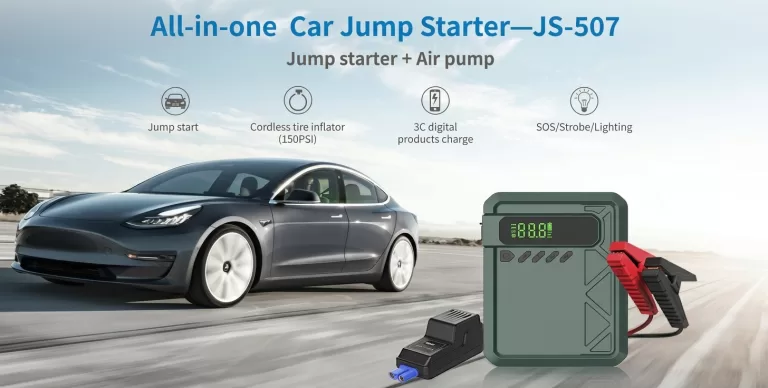
Since most passenger car V8 applications operate on standard 12V systems, the JS-557 is an ideal match. For larger vehicles, the JS-558 provides up to 3250A of peak amps, ensuring that even when the actual starting amps demand is high, the unit has enough headroom to start the engine safely.
What Size Jump Starter For V8 Engine?
After understanding the difference between passenger V8 vehicles and diesel trucks, the next practical question is: what size unit do you actually need? When searching for how many amps to jump start v8 engines, you must look at both the Starting Amps (what the car needs) and the Peak Amps (what the jump starter provides).
Popular US Vehicle:
● Honda Civic (1.5L): 400A starting / 600A peak
● Toyota Camry (2.5L): 500A starting / 800A peak
● Ford F-150 (5.0L V8): 700A starting / 1100A peak
● Chevy Silverado 6.6L Duramax: 900A starting / 1400A peak
European Vehicles:
● VW Golf (1.4L TSI): 300A starting / 500A peak
● Mercedes Sprinter (3.0L Diesel): 800A starting / 1200A peak
● BMW 3-Series (2.0L): 450A starting / 700A peak
Best Jump Starters For V8 Engines(By Peak Amps)
To ensure a successful start every time, we recommend choosing a jump starter based on its peak amps rating to provide enough headroom for the engine’s starting demand.
Normal Conditions:
▶ 800A: Compact/mid-size cars
▶ 1200A: Most cars and light trucks
▶ 1500A: All gasoline vehicles and small diesels
▶ 7000A: Heavy-duty diesels and commercial trucks (like Peterbilt or Freightliner)
Extreme Cold Adjustment
For drivers in the Northern US or Canada (-10°F to -30°F), battery efficiency drops while oil viscosity increases. To compensate:
▶ Cold Weather Adjustments:Northern US/Canada (-10°F to -30°F)
▶ Add 100-200A peak capacityAdd 200A-400A of extra Peak Amps capacity to your baseline
▶ Consider a 7000 amp jump starter for heavy-duty V8/V12 diesel engines to ensure reliable winter starting
▶ LiFePO4 batteries are highly recommended as they perform better in extreme cold weather compared to standard lithium-ion
How To Jump Start a V8 Engine?
There are 3 methods to jump start a v8 engine. For reliability and safety, use a 24v LiFePO4 battery jump starter. V8 engines often require 1500A–3000A peak current, especially in cold weather. Best dedicated 12V/24V jump starter pack delivers the necessary surge without putting strain on another vehicle’s battery.
So first ensure the jump starter voltage matches the vehicle’s electrical system (12V/24V), then connect the red clamp to the battery’s positive terminal and the black clamp to the battery’s negative terminal. Once properly connected, activate the jump starter and start the engine. Finnally, the engine starts, disconnect the clamps in reverse order.
The following describes the traditional jump-start method using another vehicle as the power source. To jump start a V8 engine, you’ll need a donor vehicle with a battery and alternator strong enough to handle the high cranking amps. Connect positive to positive, negative to ground, and let the donor car run for a few minutes before cranking the V8. However, using a small 4-cylinder car is not recommended, as its electrical system may be overstressed.
If the V8’s battery is fully shorted or drained, traditional car-to-car jumping may not work. In this case, a 24V truck jump starter or replacing the dead battery is the best solution.
Frequently Asked Questions
1.How to jump start a dead LiFePO4 battery?
There are two common methods to jump-start a dead LiFePO4 battery.First, use a battery charger with a “0V Wake-up” or “Force Mode” function to reset the internal BMS (Battery Management System). Alternatively, use a high-quality lithium jump starter with integrated safety overrides designed to provide a voltage signal to a completely drained battery.
2.How to prolong a LiFePO4 battery?
When use the LiFePO4 battery wisely,people should avoid overcharging and deep discharging.From the maintenance point,if not be in used, store at 40% or 60% charge and check every 3 or 6 months.To maximize lifespan, avoid extreme depth of discharge and overcharging. For long-term storage, keep the battery at a 40% to 60% charge level. We recommend checking the voltage every 3 to 6 months to ensure the battery remains within a healthy range.
3.What is the best overall jump starter?
As a professional manufacturer with full OEM/ODM capabilities, we believe the “best” unit depends on your specific needs. For standard passenger cars, a compact 12V unit (1200A–1500A) is perfect. However, for professionals asking how many amps to jump start v8 engines in heavy-duty commercial trucks, a heavy-duty 7000 amp jump starter is the gold standard, offering unmatched reliability and power for 12V/24V systems.
4.Is a diesel V8 better than a gas V8?
Diesel V8s offer superior longevity and torque, making them ideal for heavy-duty towing and long-haul transport. However, they are harder to start in winter. While a gas V8 is easier to maintain, a diesel V8 often requires a dedicated 7000 amp jump starter or a 24V commercial-grade booster to ensure it wakes up in extreme cold or after long periods of inactivity.