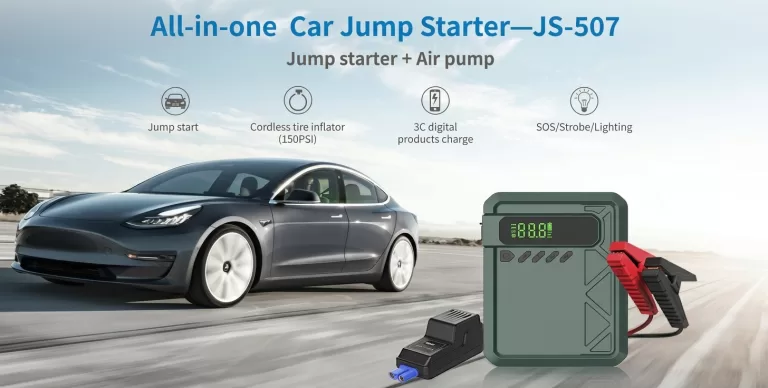



The JS629 capacitor jump starter delivers an instant 1200A peak current without relying on a traditional battery, a true battery-less jump starter. Unlike bulky lead-acid jump starter, this portable emergency super-capacitor jump starter works safely even at -45°C, supports up to 500,000 charge cycles, and eliminates fire or explosion risks. Its high-brightness LED lamp includes an SOS signal for emergency lighting, ensuring safety during roadside or outdoor use. A smarter, longer-lasting car jump starter powered by advanced super-capacitor technology.
Capacitor vs Lead-Acid: How Power Delivery Impacts Real-World Starts
There is no battery aging delay, no sluggish response only instant high-current discharge when it matters most. The following scenarios show how a capacitor jump starter outperforms traditional lead-acid models in real-world conditions.
Full Cranking Power Even at -40°C: In extreme winter temperatures down to -40°C, the capacitor jump starter delivers full cranking power instantly jump-starts 12V gasoline engines up to 6.0L and 12V diesel engines up to 3.0L, making it an ideal fast engine start super-capacitor jump starter for both personal and commercial vehicles. Whereas lead-acid batteries typically lose significant cranking performance in freezing temperatures due to slowed chemical reactions.
Rapid Energy Capture from a Weak Battery: When a car has been idle for weeks, it can recharge within minutes from a weak 12V source, traditional lead-acid jump starters depend on stored chemical energy. Over time, internal resistance increases and power delivery may weaken—especially in cold weather.
Professional or Outdoor Use: For off-road drivers, maintenance SUV enthusiasts, or workshops, super-capacitor jump starter’s rapid power delivery ensures repeated starts under demanding conditions.
Capacitor Jump Starter vs Lead-Acid: Lifespan and Durability Comparison
A typical lead-acid jump starter may experience gradual capacity loss after repeated charging cycles. Over repeated charge cycles, capacity gradually declines. Long-term storage can also result in self-discharge and sulfation, reducing overall reliability when the unit is needed most.
In contrast, the JS629 portable emergency supercapacitor jump starter operates without a built-in battery. Since there are no internal chemical degradation processes, performance remains stable over years of use. This design significantly extends the lifespan of a 12V car jump starter with supercapacitor technology.
Unlike traditional battery jump starter, a capacitor jump starter does not suffer from sulfation, internal chemical wear, or long-term capacity decay. There is no need for battery replacement over time, and maintenance requirements are minimal. The system can remain stored for extended periods while retaining operational readiness.
For SUV owners, passenger vehicles, and professional workshops, this extended durability translates into long-term reliability and reduced total cost of ownership.
How Capacitor Jump Starters Outperform Lead-Acid in Real Driving Use
Lead-acid jump starters contain liquid electrolyte and heavy metal components. Improper storage or internal short circuits can create safety concerns. The JS629, with its battery-free design and safety-grade materials, eliminates these risks and is easier to recycle thanks to its streamlined architecture.
The JS629 is safer for vehicle glove box storage, as it can remain stored for extended periods without overheating or leakage—unlike lead-acid models.
It is safer for long-term emergency kits, ensuring reliable performance even after months of inactivity, in contrast to conventional batteries that may self-discharge or degrade.
It is safer for professional roadside service, supporting repeated use under demanding conditions without the operational risks associated with traditional battery-based jump starters.
It is safer for emergency lighting, thanks to its integrated multi-mode LED system—constant illumination, flashing alert, and SOS—providing additional protection beyond engine starting.
From high-current jumps to emergency LED lighting, these FAQs explain how the JS629 capacitor jump starter keeps you prepared on the road.
Frequently Asked Questions
1.How do capacitor jump starters crank an engine?
Capacitor jump starters crank engines by delivering instant high-current output. They start reliably in both extreme cold and high heat without preheating, making them suitable for year-round use.
2.How long can a super-capacitor jump starter hold a charge?
Due to higher self-discharge, most super-capacitor jump starters retain usable charge for a few days up to 2–3 weeks when left idle. They are designed for instant starting power, not long-term energy storage.
3.What size jump starter should I choose for everyday use?
The right size depends on your vehicle type, required peak amps, portability needs, and how long the unit can hold a charge. Lithium jump starters suit most daily drivers, while other types may be chosen for specific conditions.
4.Which jump starter is better for fleet operations?
For fleets, long charge retention and low maintenance are usually more practical than peak output alone. Cold-climate fleets may benefit from sodium-ion units, while lithium jump starters are easier to manage in most regions.
5.Are capacitor jump starters good?
They recharge directly from a weak vehicle battery—no pre-charging required—deliver over 10,000 charge cycles, and remain reliable in extreme temperatures ranging from -40°F to 150°F.
6.How do you use super capacitor jump starter?
Simply connect the jump starter to the dead battery and wait 30 seconds to 3 minutes while it charges from the battery itself, then start the engine. Unlike lithium jump starters that require periodic recharging, capacitor models stay ready indefinitely without ongoing maintenance.
7.Is the JS629 A Battery Charger?
No. The JS629 is a super-capacitor jump starter, designed to deliver a high-current burst to crank your engine—not to recharge a dead battery.
8.Will it really work in extreme cold like -45°C?
Yes. The JS629 can operate in temperatures down to -45°C (-49°F), maintaining reliable engine starting even in extreme winter conditions.