
Dead batteries strike without warning, leaving drivers stranded and facing expensive towing fees that can reach $100-200 per service call. A portable jump starter eliminates this costly dependency on roadside assistance, paying for itself after just one use.But this gift isn’t just about saving money—it’s about giving Dad the independence to take control in emergencies. These compact powerhouses keep him protected from weather delays, unavailable services, or long waits on the roadside.
Still wondering if it’s the right gift? Many drivers ask:Will a jump starter work on a completely dead battery?The answer depends on understanding the difference between a “dead” battery and a deeply discharged one – and choosing the right technology to handle both scenarios.
 lithium-battery-manufacturer-from-china
Will a jump starter work on a completely dead battery?
A jump starter can work on a completely dead battery, jump-starting a vehicle could help saving time but with some important limitations:
When it will work:
1.If the battery is simply deeply discharged but still functional.
2.When the battery cells haven’t been damaged by the complete discharge.
3.If the jump starter has enough power output for your vehicle’s engine size.
Before attempting to use an emergency jump starter, ensure the vehicle is unable to start. If it fails to work, the following three steps will help you understand what to do next.
1.If the battery has been dead for an extended period (weeks/months), it may have suffered permanent damage.
2.Very old batteries that can no longer hold any charge.
3.If there’s internal cell damage or the battery has frozen.
How long does the battery in a portable jump starter last?
The battery life of a portable jump starter depends on several factors, but here’s what you can expect:
1.The Storage Time of JS-318 Portable Jump Starter:
Most quality portable jump starters hold their charge for 3-6 months when not in use. Some premium models can maintain charge for up to a year, though it’s best to recharge them every 3-4 months to maintain optimal performance.
2.Active Use Capacity of Carku JS-318 Portable Jump Starter:
▶Jump starting: A fully charged unit can typically perform 10-20 jump starts on a single charge, depending on your vehicle size and the starter’s capacity
▶Device charging: Can charge phones 4-8 times, tablets 2-3 times
▶LED flashlight: Usually runs 6-12 hours continuously
If you wish to determine the recharge time, statistics indicate that most units require 4-8 hours to fully recharge when plugged into a wall outlet, although some support fast charging within 2-3 hours.It depends on the several key factors.
1.Recharge time:Should support for fast charging be implemented?
Battery capacity:Larger capacity units (20,000 mAh) naturally take longer to charge than smaller ones (10,000 mAh). Higher capacity means more energy storage, requiring more time to fill.
2.Charging input power of JS-318 Portable Jump Starter:
▶Standard chargers (1-2 amps): 6-8 hours
▶Fast chargers (3-5 amps): 2-4 hours
▶USB charging: Much slower, 8-12+ hours
3.Battery chemistry of JS-318 Portable Jump Starter:
▶Lithium-ion: Charges faster and more efficiently
▶Lead-acid: Slower charging, often 6-8 hours minimum
▶LiFePO4: Good balance of speed and longevity
4.Current battery level:A completely dead unit takes full time, while topping off from 50% might only take 2-3 hours.
5.Temperature Conditions:
Cold temperatures significantly slow charging speed, while moderate temperatures (60-80°F) allow optimal charging rates.
6.Charger quality:
Original manufacturer chargers are optimized for the specific unit, while generic chargers may charge slower or less efficiently.
7.Age of the Unit:
Older jump starters may charge more slowly as the battery cells degrade over time.
What is the difference between a battery booster and jump starter?
While the terms are often used interchangeably, there is a subtle difference worth noting—especially if you’re shopping for something practical this Father’s Day.
A battery booster typically refers to a larger, heavier unit designed to deliver a high power surge, often used in professional settings or garages. These units usually rely on being plugged into a power source and are less portable.
A jump starter, especially a portable vehicle jump starter, is a compact, all-in-one device designed for everyday drivers. It contains its own internal battery and is small enough to fit in your glove compartment. It allows you to jump-start your car anytime, anywhere—without needing another vehicle or wall outlet.
Modern Portable Units: Today’s portable vehicle jump starters actually combine both functions. They can provide instant jump-starting power while also offering a “boost mode” that slowly charges your battery first.
For most drivers, a quality portable jump starter is the better choice since it offers versatility and convenience. With Father’s Day approaching, these multi-functional units make excellent gifts for dads who value preparedness and self-reliance on the road.
What to look for when buying a portable jump starter?
Vehicle Jump Starter Power: Understanding Peak Amps & Battery Capacity
The most critical specification to consider is the cranking amps and peak amps rating. These numbers determine whether your jump starter can successfully start your vehicle’s engine. For most passenger cars, look for units with at least 400-600 peak amps, while larger vehicles like trucks or SUVs may require 800-1000+ peak amps. The battery capacity (measured in mAh) affects how many jump starts you can perform on a single charge and how long the unit will hold its charge between uses.
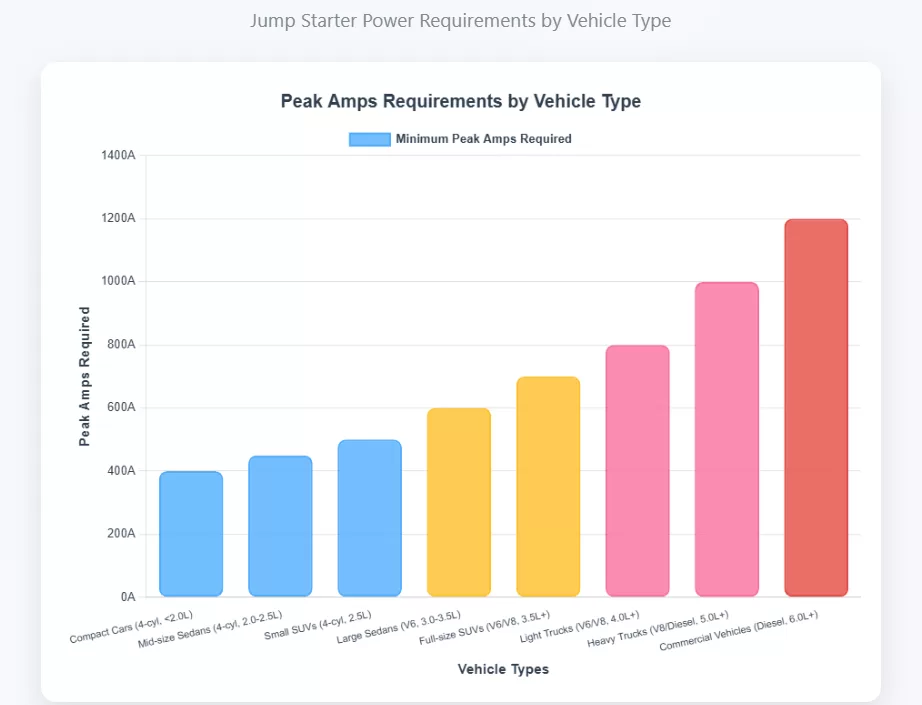
Peak Amps Requirements by Vehicle Type
12v vs 24v Vehicle Jump Starters: Compatibility & Multi-Use Features
Modern portable jump starters offer much more than just jump-starting a car. Look for multifunctional units that support both 12volt vs 24volt systems – 12volt for passenger vehicles and 24-volt for commercial trucks or heavy equipment. Many units also feature USB outputs for charging smartphones, tablets, and other devices, plus LED flashlights and emergency strobe functions. This multifunctional design makes them valuable batterypack solutions beyond automotive use.
Essential features of a compatible jump starter:
▶12v vs 24v compatibility for different vehicle types
▶Multiple USB ports for device charging
▶Built-in LED flashlight and emergency signals
▶Multifunctional design for various power needs
An multifunctional feature is more than just an emergency tool for starting your engine.It’s a versatile, all-in-one roadside assistant.A jump starter with air compressor is beneficial for jump-starting dead car batteries, here are the key features and functions users love:
1.Tire Inflation (Built-in Air Compressor)
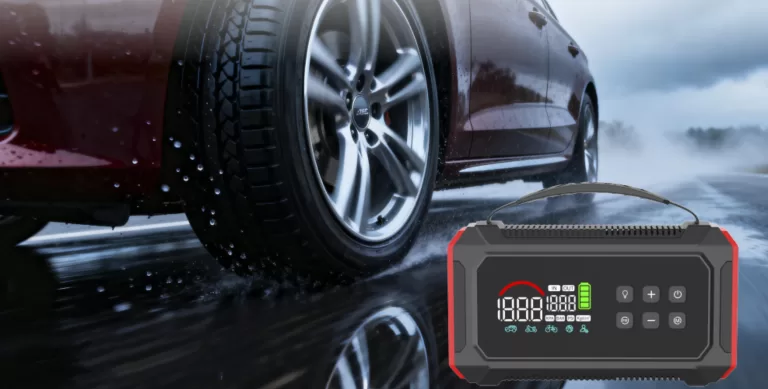
The integrated air compressor allows you to inflate car, bike, or motorcycle tires on the go. Most models support pressure settings up to 100-150 PSI, and some come with digital gauges and auto shut-off to prevent over-inflation.
The Carku JS-557 jump starter with air compressor compares the JS-318 jump starter as follows.The JS-557 is your go-to solution for daily emergency car use and tire inflation. Whereas the JS-318 for outdoor power needs, AC/USB versatility, and higher battery capacity.
Table shown: JS-557 AND JS-318 JUMP STARTER
| JS-557 JUMP STARTER | JS-318 JUMP STARTER |
| 10,000 mAh | 225Wh = 60,000mAh |
| 1500A | 1100A |
| 12v 5.0L gasoline / 2.0L diesel | 12v 6.0L gasoline / 4.0L disel |
| Built-in 150 PSI Air Compressor | AC inverter output, PD100w output |
| Fast inflation; support cars, SUVs, bikes, etc. | External air pump via DC output |
| Smart Digital LCD Screen | 2.4-inch Display screen |
| 10 protections / Multiple Certifications | 10 protections / Multiple Certifications |
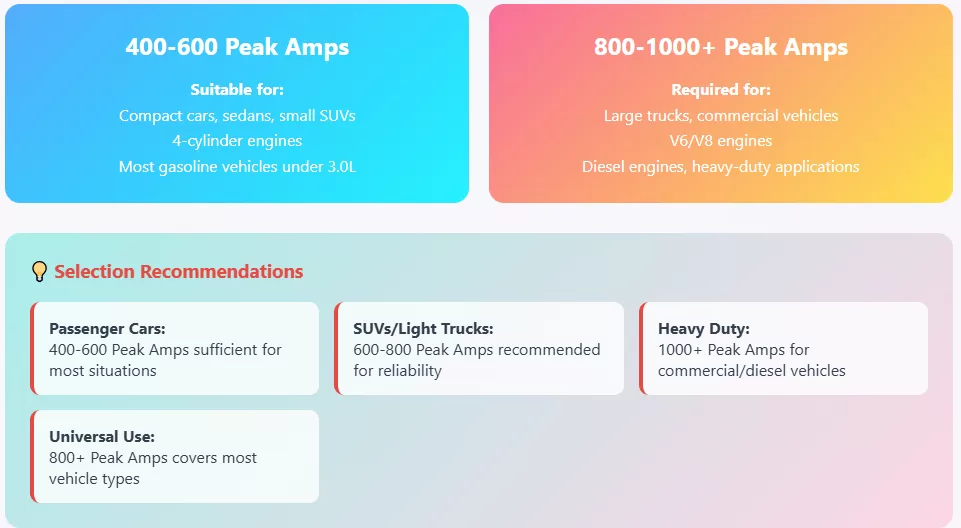
JUMP STARTER POWER REQUIREMENTS BY VEHICLE TYPE
JUMP STARTER POWER REQUIREMENTS BY VEHICLE TYPE
2.USB Charging for Devices
Equipped with USB-A or USB-C output ports, these jump starters double as portable power banks. Perfect for charging smartphones, tablets, cameras, or even small gadgets during road trips or emergencies.
3.Emergency LED Flashlight
Most units come with a built-in LED flashlight that includes multiple modes: steady beam, strobe, and SOS. This is useful for nighttime repairs, flagging down help, or navigating in the dark.
4.Versatile DC/12V Output
Some models include a 12V DC socket or cigarette lighter port, letting you power small appliances like car vacuum cleaners, mini coolers, or portable fans.
5.Compact Power Station Capabilities
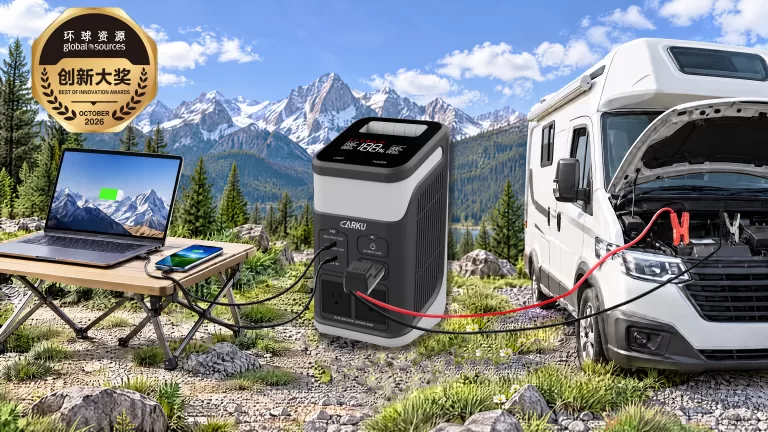
These multi-function jump starters are designed to be your mobile energy hub—ideal not only for emergency roadside use but also for camping, tailgating, and other off-grid scenarios.Choosing the Right Battery Technology for Your Vehicle Jump Starter
6.Safety-First: Essential Protections in Vehicle Jump Starters
7.Portable Design Matters: Size, Weight & Storage of Vehicle Jump Starters
Is it safe to keep a jump starter in a car in summer?
Some summer car emergency battery tips are the following. Protecting jump starter from heat is vital for processing the emergency jumping car safely and effectively.Firstly,understanding battery chemistry performance in high heat (Lithium vs Lead-Acid vs LiFePO4).Different battery technologies respond differently to extreme heat, making your choice critical for summer reliability:
Lithium-ion batteries are most vulnerable to high temperatures. Exposure to temperatures above 140°F (60°C) can cause thermal runaway, leading to swelling, reduced capacity, or even fire hazards.Lead-acid batteries have better heat tolerance but suffer from accelerated electrolyte evaporation and sul-fation in high temperatures. LiFePO4 (Lithium Iron Phosphate) batteries offer superior thermal stability with safe operation up to 160°F (71°C). They maintain stable performance in summer heat and include built-in thermal management systems that prevent dangerous overheating. This makes LiFePO4 the safest choice for year-round vehicle storage.
Secondly,the safe storage strategies for jump starters.Avoid direct sunlight exposure – Never leave your jump starter on the dashboard, rear window shelf, or any area receiving direct solar radiation. Interior vehicle temperatures can reach 200°F (93°C) in summer.Choose cooler vehicle locations – Store in the glove compartment, under seats, or in the trunk’s shaded areas. These locations typically stay 20-30°F cooler than exposed surfaces.Use insulated storage bags – Invest in reflective or insulated carrying cases that provide additional thermal protection. Some manufacturers offer heat-resistant storage solutions specifically designed for extreme temperatures.Consider portable storage – For extended parking in hot climates, remove the jump starter and store it indoors when possible. This eliminates heat exposure entirely during peak temperature hours.
Thirdly,temperature monitoring and maintenance protocols.Heat exposure gradually reduces battery capacity. Test your jump starter monthly during summer to ensure it maintains sufficient power for emergency starts.So recycling battery pack is important for environmental protection, resource conservation, and regulatory compliance. Proper battery pack recycling ensures that valuable materials return to the manufacturing cycle while preventing environmental contamination, making it a critical responsibility for all jump starter users.
This Father’s Day, skip the ties and mugs.Give the gift that starts engines, saves time and money, and shows Dad you’ve got his back—no matter where the road takes him.
Frequently Asked Questions
1.What size vehicle jump starter do I need?
For small sedans and compact cars: 400A–600A is usually enough.For SUVs, trucks, or diesel engines: look for 800A–1100A, like the JS-318, for reliable starts in all conditions.
2.Can a vehicle jump starter charge other devices?
Yes,a vehicle jump starter can charge other devices.especially a multi-functional unit like the JS-318 — can charge or power a wide range of electronic devices, making it a versatile tool for road trips, outdoor adventures, or emergency power outages.
3.How long does a jump starter stay charged?
For the JS-318 jump starter, which features a large 225Wh lithium battery, you can expect:3 to 6 months of charge retention when stored properly (indoors, at moderate temperatures).It’s recommended to recharge every 3 months to maintain peak performance.